“They crucified him.”
– Luke 23:33
Execution,
but make it legal.
State-sanctioned.
Publicly justified.
The necessary cost of maintaining order.
Rome calls it peace.
Religion calls it righteousness.
A man is nailed to wood
and the crowd is told it is for the greater good.
Sound familiar?
Missiles launched.
Cities flattened.
Children buried under language like “strategic necessity.”
Gaza reduced to rubble.
Lebanon burning.
Iran and Israel trading fire across the sky.
And somewhere –
Christians ask, with straight faces:
Who would Jesus bomb?
We have traded the Lamb who was slain
for the lion who slays.
We name our operations with the language of gods –
Epic Fury, High Pressure –
as if we are the dispensers of divine justice.
As if wrath belongs to us.
As if devastation is divine when we author it.
Forgetting –
that when God finally came in the flesh,
he did not bring fury.
He brought a towel.
He brought a cross.
He brought a refusal to strike back.
Would he target militants?
Would he accept collateral damage?
Would he call it regrettable but necessary?
Or would he be there—
in the dust,
under the concrete,
numbered among the dead?
“Father, forgive them,” he says.
– Luke 23:34
Not:
Father, justify them.
Father, endorse their airstrikes.
Father, bless their military superiority.
Forgive them.
Because they do not know what they are doing.
Or worse –
because they do,
and call it peace anyway.
And for some –
the rubble is not even tragedy.
It is a checklist.
Prophecy unfolding.
End times advancing.
Salvation getting closer.
We have turned the suffering of millions
into a spectator sport
for our own redemption.

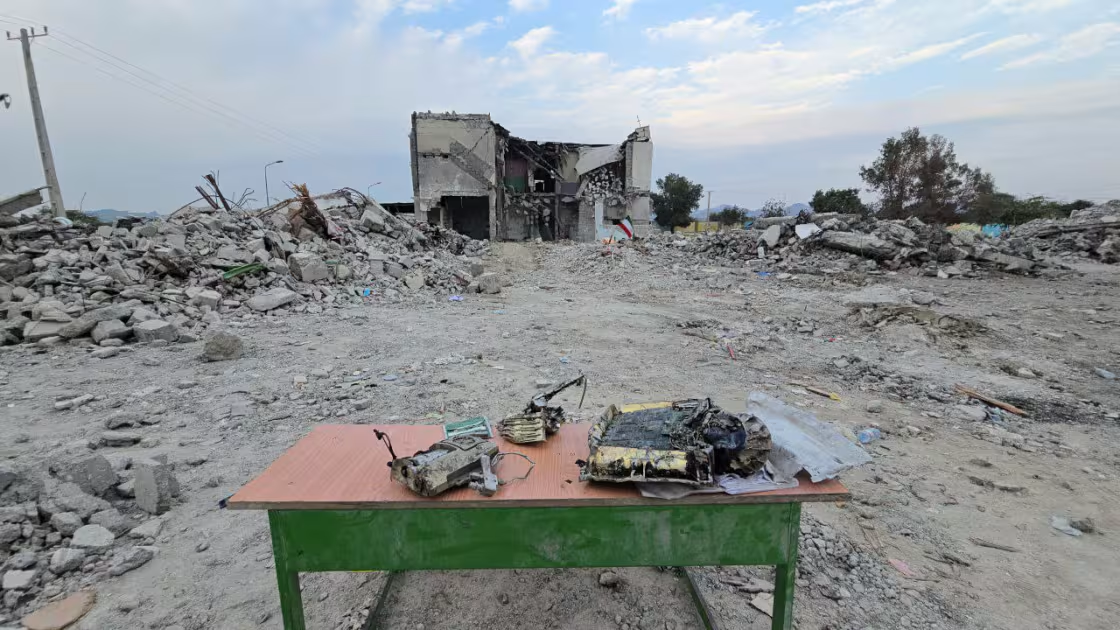
Reflection
Crucifixion was a tool of empire.
It was designed to demonstrate power, enforce control, and eliminate perceived threats under the cover of legality.
To follow a crucified Messiah is to stand in opposition to that logic.
And yet, some strands of Christianity have become entangled with it – seeing military dominance not as a contradiction of faith, but as its extension.
The language of sacrifice has been inverted.
No longer the Lamb who absorbs violence,
but a theology that justifies inflicting it.
When war becomes sacred,
the cross is no longer understood.
Jesus was not the one authorising the violence.
He was the one subjected to it.
Discover more from The Broken Church
Subscribe to get the latest posts sent to your email.
 The Broken Church