For more than 1,300 years the Church repeated a claim about Mary Magdalene that the New Testament never actually makes.
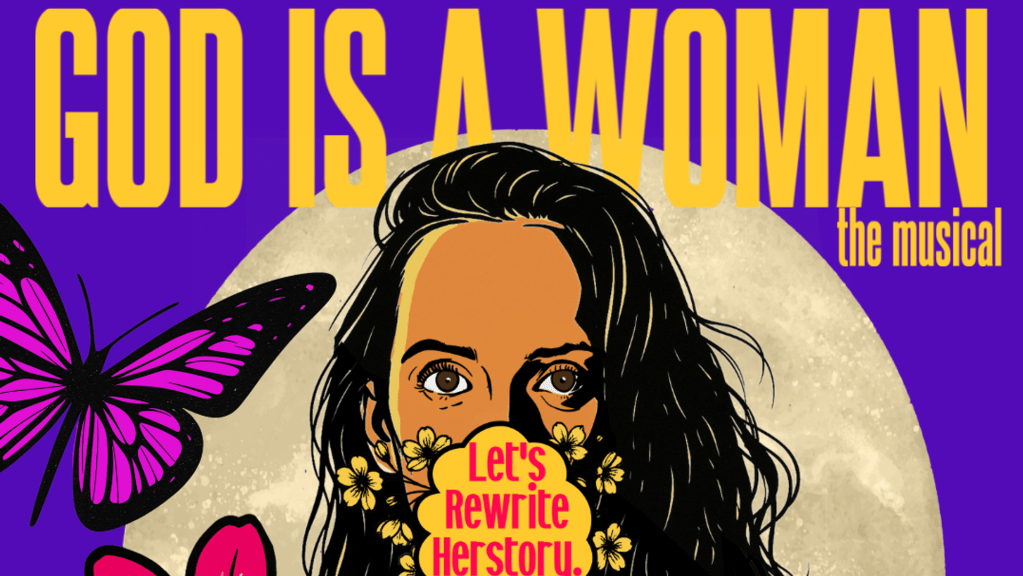
Last weekend I sat in a theatre and watched a comedian do something many preachers do not dare to attempt. Luisa Omielan stood on stage with her show God Is a Woman The Musical and told the truth about the Church.
Not a cheap truth.
Not an easy truth.
A researched, historical, documented truth.
I laughed. Properly laughed. The kind of involuntary, head-back, slightly undignified laugh that makes strangers feel like comrades.
God Is a Woman is first of all extremely funny. It is sharp, fearless, and tightly crafted. You can feel the years of work in it. Who knew centuries of church history could be brought into a room and land as both belly laughs and deep truths?
In 591, Pope Gregory I (known widely as Gregory the Great)[i] preached a homily that would alter the reputation of one woman for over 1,300 years. In Homily 33 on the Gospels, he conflated Mary Magdalene with two other women in the Gospels: the unnamed “sinful woman” who anoints Jesus’ feet in Luke 7[ii], and Mary of Bethany, sister of Martha.[iii],[iv] Three distinct women became one composite figure. With that interpretive move, Mary Magdalene’s leadership and authority were eclipsed by a narrative of sexual sin and shame – a remarkably effective way of ensuring a prominent female leader could no longer be taken seriously.
For over thirteen centuries the Church repeated the claim that Mary Magdalene was a prostitute.
The New Testament never says that.
Luke names her as one “from whom seven demons had gone out,” likely a reference to severe illness or profound liberation (Luke 8:2–3). Mark places her at the crucifixion when many male disciples have fled (Mark 15:40–41). John records her as the first witness to the resurrection and the one entrusted with the news, “I have seen the Lord” (John 20:18). In the ancient world, testimony mattered. Credibility mattered. The Gospels deliberately place the central claim of Christianity in the mouth of Mary Magdalene. She is entrusted with the announcement that Christ is risen. In that sense, she stands as the apostle to the apostles.
That is not accidental.
In 1969, the Roman Catholic Church revised the “General Roman Calendar” as part of the reforms following the Second Vatican Council, removing the liturgical readings that had tied Mary Magdalene to the unnamed “sinful woman” and Mary of Bethany. The reform affirmed her identity as the disciple present at the tomb and witness to the resurrection without that composite identity.[v] There was no public apology, no press conference. Just a liturgical correction. The damage, however, had already been done.
History flattened her.
Patriarchy domesticated her.
The pulpit misnamed her.
That is the soil from which God Is a Woman grows.
Omielan draws not only on the canonical Gospels but also on the ‘Gospel of Mary’, an early Christian text known from the Berlin Codex, in which Mary appears as a visionary leader whose authority is contested by male disciples.[vi] It is not hard to see why texts like this were excluded from the canonical New Testament: they had a very different picture of early Christian community and authority.
The show argues for matriarchy. Not anti-men. Not female domination. A rejection of hierarchy that concentrates power in the hands of the few. A circle instead of a triangle.
Some will call it blasphemous. Omielan imagines a “romantic relationship” between Mary and Jesus (this is my soft biblical phrasing; you are invited to read between the lines or perhaps, the sheets). She names God as woman. For anyone who reads scripture honestly, that is not quite the scandal some suppose. The Holy Spirit is described in feminine language within the biblical tradition, and the Trinity cannot be reduced to a simplistic male projection. Perhaps God’s identity has always exceeded our binaries.
Others will object to the so-called “rude” or “crude” moments.
Yes, the show talks about sex. It talks about periods. It refuses the polite silences religion enforces around women’s bodies – silences that are particularly absurd when you consider God to be the ultimate architect. At one-point Omielan raises the theological question (one raised by former Archbishop of Canterbury, Rowan Williams, back in 1989), [vii] why does the clitoris exist? The clitoris being the only part of the human body designed purely for joy. If God were male, that is an interesting design decision. If God is a woman, it might be the cherry on the cake.
There will be those who find this offensive. The same people, perhaps, who are entirely comfortable with centuries of institutional misogyny but draw the line at menstruation being mentioned in a theatre.
The irony writes itself.
Beyond the laughter there is something else.
What struck me most was the combination of sharp critique and genuine longing. Anger at systemic abuse. Frustration at what the Epstein files reveal about the endurance of male impunity. There is also vulnerability, honesty, and a desire for something better. Omielan challenges the Church, with intelligence and a strange kind of respect. It doesn’t feel like demolition for sport; it feels like a demand for transformation with a longing to organise, to move from frustration to action, to build something better.
And throughout it all, Bernie (Luisa’s enormous, beautiful, Bernese Mountain dog) shares the stage, quietly guarding something sacred.
I left thinking not simply, “That was funny,” but, “That was prophetic.” Not prediction, but truth-telling. A refusal to let inherited narratives sit unchallenged. Naming what has been distorted. Exposing what has been normalised. Speaking truth to power. I found it refreshing to hear someone speak about Christianity and the Church through a lens so different from my own, yet with such intelligence and honesty. It’s rare to encounter that combination of challenge and care.
Omielan’s interrogation of Mary Magdalene belongs to a much larger movement of women digging through the debris of history to find themselves. It is a process of looking at the same evidence we’ve seen for years, but finally seeing it through a different lens. Sandi Toksvig describes this shift in perspective beautifully:
“When I was a student at Cambridge I remember an anthropology professor holding up a picture of a bone with 28 incisions carved in it. ‘This is often considered to be man’s first attempt at a calendar’ she explained. She paused as we dutifully wrote this down. ‘My question to you is this – what man needs to mark 28 days? I would suggest to you that this is woman’s first attempt at a calendar.’”
“It was a moment that changed my life. In that second I stopped to question almost everything I had been taught about the past. How often had I overlooked women’s contributions? How often had I sped past them as I learned of male achievement and men’s place in the history books? Then I read Rosalind Miles’s book The Women’s History of the World (recently republished as Who Cooked the Last Supper?) and I knew I needed to look again. History is full of fabulous females who have been systematically ignored, forgotten or simply written out of the records. They’re not all saints, they’re not all geniuses, but they do deserve remembering.”[viii]
How often have we misattributed women’s insight?
How often have we flattened their leadership?
How often have we spiritualised exclusion?
As I was finishing this piece, news broke that a group of conservative Anglicans has established a new council to lead the global Anglican Communion, in a direct challenge to the authority of the Archbishop of Canterbury, the Rt Revd and Rt Hon Dame Sarah Mullally, as she is about to be installed as the first woman in the history of the Anglican Communion to hold its highest office.[ix] The timing is hard to ignore. Just days before International Women’s Day, and just as a woman prepares to assume one of the most visible leadership roles in global Christianity, a movement emerges seeking to relocate authority somewhere else. After thirteen centuries of defaming Mary Magdalene, the pattern feels uncomfortably familiar. Authority is granted to a woman, and suddenly the structure itself is questioned. History may not repeat itself exactly, but it has a habit of rhyming.

God Is a Woman is not an academic lecture. It is not a doctrinal treatise. It is a comedy show. But it is also an interrogation of memory. It asks what else we have inherited uncritically. It asks who benefitted from that inheritance.
For those within the Church, especially clergy, it would be easy to dismiss the show as irreverent. That would be convenient. It would also be wrong.
It holds up a mirror.
And on International Women’s Day, the Church would do well to look into it.
[i] Pope Gregory I, “Homily 33,” in Gregory the Great: Forty Gospel Homilies, trans. David Hurst, Cistercian Studies Series 123 (Kalamazoo, MI: Cistercian Publications, 1990), 269.
[iv] Magdalena Jóźwiak, “The Apostle of the Apostles, Prostitute or Penitent? A Typology of Mary Magdalene in the Homilies of Gregory the Great,” Verbum Vitae 42, no. 4 (2024): 871-886, https://hdl.handle.net/20.500.12153/8310.
[v] Liturgical reforms under Pope Paul VI, “Mysterii Paschalis, Apostolic Letter implementing the revised General Roman Calendar (1969)”; Liturgical Notes on the Feast of St Mary Magdalene (New Liturgical Movement), https://www.newliturgicalmovement.org/2021/07/apostle-of-apostles-liturgical-notes-on.html.
[vi] Karen L. King, The Gospel of Mary of Magdala: Jesus and the First Woman Apostle (Santa Rosa, CA: Polebridge Press, 2003).
[vii] Rowan Williams,The Body’s Grace, (ABC, August 24, 2011), Originally delivered as the ‘10th Michael Harding Memorial Address’ to the Lesbian and Gay Christian Movement (1989), https://www.abc.net.au/religion/the-bodys-grace/10101214 (accessed 3 March 2026).
[viii] Sandi Toksvig, Sandi Toksvig’s Top 10 Unsung Heroines, (The Guardian, 28 October 2009), https://www.theguardian.com/books/2009/oct/28/sandi-toksvig-unsung-heroines (accessed 3 March 2026).
[ix] Camillus Eboh and Elisha Bala-Gbogbo, “Conservative Anglicans Say They Want to Be Led by a Council, Not Archbishop of Canterbury”, (Reuters 5 March 2026), https://www.reuters.com/world/africa/conservative-anglicans-say-they-want-be-led-by-council-not-archbishop-canterbury-2026-03-05/ (accessed 5 March 2026).
Note: At the time of publication Luisa Omielan is touring her self-produced and self-funded show God Is a Woman The Musical (note, it’s not actually a musical) with dates through March and April (many of which have sold out) in London, Leeds, Norwich, and Leicester. Tickets are available from her website and you can also support her work through Patreon. Plus she’s on all the usual socials.
Discover more from The Broken Church
Subscribe to get the latest posts sent to your email.
 The Broken Church